

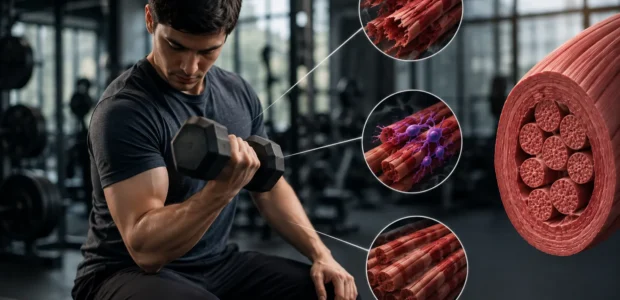

Lift weights, get bigger. That’s the simple version everyone learns early on, and it’s not wrong, exactly. But it skips over one of the more genuinely fascinating processes happening inside your body every time you train. How does muscle growth actually work isn’t really about effort alone, it’s a specific biological chain reaction, one that starts the moment you pick up a weight and continues for days after you’ve put it down.
Let’s walk through what’s really happening at the cellular level, step by step.
It Starts With Tension, Not Soreness
Here’s a common misconception worth clearing up first. A lot of people assume soreness is the whole point, if you’re not wrecked the next day, you didn’t do enough. That’s not quite right. The real primary driver behind muscle growth is mechanical tension, the actual force placed on a muscle as it works against resistance.
Soreness and microscopic muscle damage do play a role in the process, but they’re a byproduct, not the actual trigger. You can build plenty of muscle without feeling destroyed the next morning, as long as you’re creating enough tension in the right way.
How Does a Muscle Grow at the Cellular Level
Your muscle fibers are made up of myofibrils, the tiny contractile units responsible for actually producing movement. When you lift something heavy enough to challenge those fibers, resistance training creates tiny tears throughout them. That might sound alarming, but these aren’t injuries in the harmful sense, they’re a signal, your body’s cue that it needs to adapt and come back stronger.
This is really the direct answer to how does a muscle grow, a repeated cycle of microscopic tears followed by a targeted repair response.
The Repair Process: Where Satellite Cells Come In
Once those tiny tears happen, your body doesn’t just patch things up randomly. It calls in satellite cells, a type of muscle stem cell that rushes to the site of the damage. These cells fuse directly with your existing muscle fibers, helping rebuild and reinforce the areas that took on stress during your workout.
The result isn’t just a repair job either, it’s an upgrade. The fibers that come back are thicker and more resilient than they were before, which is exactly what allows you to handle a bit more weight or a few more reps the next time around.
Read More: The Role of Protein in Muscle Recovery
Protein Synthesis: The Actual Growth Step
Here’s something that surprises a lot of people, your muscles don’t actually multiply when you train. The fibers you already have simply get thicker over time. This happens because your body ramps up the production of new proteins inside each fiber faster than it breaks old ones down, and that net gain in protein is what physically enlarges the fiber.
Amino acids from the protein you eat are the raw material fueling this entire rebuilding process, which is exactly why nutrition matters just as much as the workout itself. This step is really the heart of how does muscle growth work, a slow, steady accumulation of protein happening inside each fiber, workout after workout.
Two Types of Growth: Strength vs. Size
There’s a nuance here that most people never learn. Muscle growth actually splits into two categories. Myofibrillar hypertrophy increases the number of contractile units packed into each fiber, which translates directly into more strength. Sarcoplasmic hypertrophy, on the other hand, increases the fluid and energy storing components surrounding those units, boosting your work capacity without necessarily adding raw strength.
Most training produces a mix of both, which explains why two people with similarly sized muscles can have noticeably different strength levels. It’s a small detail, but it says a lot about how the body grows muscle in ways that go beyond just getting bigger.
The Three Ingredients That Make It All Happen
Three overlapping factors drive this whole process. Mechanical tension is the load placed on the muscle during training. Muscle damage refers to the minor, necessary microtears created along the way. Metabolic stress is that familiar burning sensation from higher rep, shorter rest training. None of these three works entirely alone, they overlap and reinforce each other, which is part of why varying your training style tends to produce better results than sticking to one approach forever.
What This Means for Your Training
Understanding the science translates into a few practical habits. Progressive overload, gradually increasing weight, reps, or intensity over time, is what keeps this entire cycle moving forward. Without it, your muscles have no real reason to keep adapting.
Recovery and protein intake matter just as much as the workout itself too, since the actual growth happens during rest, not during the lift. If you’re looking to support that recovery process with the right supplements or gear, Stay Fit Deals brings together discounts across a wide range of fitness and supplement brands, all in one place, making it easier to stock up on what your training actually needs without overspending.
The Bottom Line
How does the body grow muscle, in the end, comes down to a repeating cycle, tension, repair, and protein synthesis, working together again and again over time. Understanding what’s actually happening beneath the surface makes it a lot easier to train smarter, not just harder, and to trust the process even on the days when progress feels slow.