

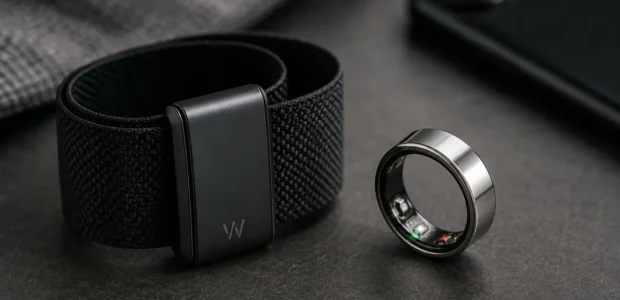

Once you’re past the smartwatch phase and ready for something more focused on recovery and sleep, Whoop vs Oura is pretty much the debate everyone ends up having. Here’s the thing though, it’s not really about which one is objectively better. It’s about which one actually fits your training style, your daily habits, and how you feel about paying for a subscription versus owning your hardware outright. Let’s break down how the current models, Whoop 5.0 and Oura Ring 5, actually compare.
Form Factor: Ring vs Band
This is really the first decision point in whoop band vs oura ring, and it comes down to how each device sits on your body. The Oura Ring is nearly invisible, looking more like a piece of jewelry than a fitness tracker, which means you can wear it comfortably in professional settings or out at dinner without a second glance. The tradeoff is that a ring can get in the way during heavy lifting or activities where your hands are under a lot of pressure.
Whoop takes the opposite approach. There’s no screen at all, and the band sits comfortably on your wrist or bicep without interfering with most activities. The only way to actually check your data is through the phone app, which sounds like a limitation at first, but plenty of users find it genuinely helpful, less checking your strain score mid workout, less overall data obsession.
Battery Life: A Clear Whoop Advantage
If charging routines stress you out, this category matters a lot. Whoop 5.0 is rated for 14 days of battery life, and real world use tends to hold at that mark or slightly beyond for most people. Its on wrist PowerPack slides right over the band while you’re still wearing it, meaning you never actually remove the device to charge it, and your tracking never loses continuity.
Oura Ring 5 improved its battery situation too, now rated between 6 and 9 days per charge, up from the previous generation despite the ring itself getting smaller. It charges on a small magnetic USB dock, and an optional charging case, priced separately, can extend that window even further. Between the two, Whoop clearly wins on raw battery convenience.
Is Oura Ring or Whoop More Accurate?
This is one of the most common questions people ask before buying either device, and the honest answer is that both perform well, just in slightly different areas. Oura has been validated in published research for its HRV precision and sleep staging accuracy, comparing favorably against lab based sleep studies. Whoop has also been compared against polysomnography and found reasonably accurate, and it pairs that accuracy with a dedicated Strain Coach that actively ties your recovery data to your daily training load.
So is Oura Ring or Whoop more accurate really depends on what you’re measuring. Oura edges ahead specifically on validated sleep accuracy, while Whoop edges ahead on translating that data into real time training guidance you can act on immediately.
Features That Set Each One Apart
Whoop leans heavily into performance coaching. Its Strain Coach tells you whether your body can handle a hard session or needs recovery, and it’s added features like women’s hormonal insights, a Healthspan metric that estimates your biological age and pace of aging, and on demand clinician access on its higher membership tiers.
Oura leans more toward lifestyle and early warning signals. It tracks daytime stress and resilience through heart rate and HRV patterns, and its temperature trend tracking has genuinely helped users catch early signs of getting sick before symptoms even show up. It doesn’t offer the same interactive coaching system Whoop provides, but for many people, that’s simply not what they’re looking for from a ring.
Pricing: Subscription vs Ownership
Oura requires a one time hardware purchase, with the Ring 5 starting around $399, plus a membership fee to actually see your data. If you cancel the membership, you still keep the physical ring. Whoop works entirely differently, there’s no upfront hardware cost at all, the device comes bundled into your annual membership. The catch is that if you cancel, the hardware has to be returned, since you never technically owned it.
| Oura Ring 5 | Whoop 5.0 | |
|---|---|---|
| Hardware cost | Around $399, one time | None, bundled into membership |
| Entry tier | $5.99/month or $69.99/year | Whoop One, $199/year |
| Mid tier | Same membership, one price | Whoop Peak, $239/year |
| Top tier | Optional charging case, $99 | Whoop Life (includes WHOOP MG), $359/year |
| If you cancel | You keep the ring | Hardware must be returned |
| Ownership model | You own the hardware | You subscribe to the platform |
Once you know which pricing model fits your budget, it’s worth checking Stay Fit Deals before you buy either one. The site regularly features discounts and coupons across a wide range of fitness brands, including wearables and recovery tech, making it easier to save on whichever device you choose without paying full price upfront.
Which One Should You Actually Buy
Choose Oura if you want a discreet, jewelry like design, care most about validated sleep accuracy, and would rather own your hardware outright without an ongoing commitment tied to it. Choose Whoop if you’re a serious athlete who wants strain based training guidance, don’t mind skipping the screen entirely, and are comfortable with a subscription model that bundles in your hardware.
This really isn’t about finding the objectively superior device, it’s about matching the tool to how you actually train and live day to day.
The Bottom Line
Whoop vs oura comes down to a handful of real, practical tradeoffs, form factor, battery convenience, and whether you’d rather own hardware or subscribe to a platform that includes it. Both are genuinely excellent recovery trackers in their own right, so the right pick is simply the one that fits naturally into your actual routine, not whichever one wins on paper.