

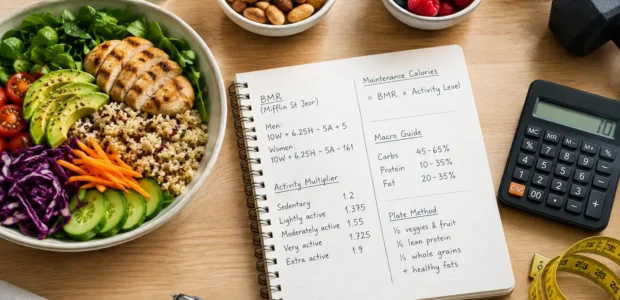

How many calories should you actually eat in a day? It sounds like a simple question, but most people either guess based on a generic number they saw once online, or just eat whatever feels normal and hope for the best. Neither approach has much to do with your actual body. How to calculate maintenance calories really comes down to two numbers, your BMR and your activity level, multiplied together. Let’s walk through the full formula from scratch, separate breakdowns for men and women, and what a genuinely balanced meal looks like once you know your number.
What Are Maintenance Calories, Exactly?
Maintenance calories are simply the number of calories your body needs each day to stay at the same weight, neither gaining nor losing. You’ll also see this number called TDEE, short for total daily energy expenditure. It’s made up of two parts working together, your BMR, which is what your body burns just sitting completely still, and your activity level, which accounts for everything else you do on top of that baseline.
Step 1: Calculate Your BMR
BMR stands for basal metabolic rate, and it represents the calories your body needs just to keep your organs running, before any movement, exercise, or even digestion enters the picture. Think of it as the cost of simply staying alive for 24 hours.
The most widely trusted way to estimate this is the Mifflin St Jeor equation, considered one of the most accurate predictive formulas for healthy adults and endorsed by the Academy of Nutrition and Dietetics. Here’s how to calculate maintenance calories for men using this formula, take your weight in kilograms times 10, add 6.25 times your height in centimeters, subtract 5 times your age, then add 5.
As an example, a 30 year old man weighing 80 kilograms at 178 centimeters tall would calculate it like this, 10 times 80 equals 800, plus 6.25 times 178 equals 1,112.5, minus 5 times 30 equals 150, plus 5. Add those together and his BMR lands right around 1,767 calories.
For how to calculate maintenance calories for women, the formula is nearly identical, just subtract 161 at the end instead of adding 5. A 28 year old woman weighing 65 kilograms at 165 centimeters tall would work it out as, 10 times 65 equals 650, plus 6.25 times 165 equals 1,031.25, minus 5 times 28 equals 140, minus 161. Her BMR comes out to roughly 1,380 calories.
Step 2: Apply Your Activity Multiplier
Once you have your BMR, the next step is multiplying it by a number that reflects how active you actually are day to day. The standard multipliers break down like this, sedentary with little to no exercise uses 1.2, lightly active with light exercise one to three days a week uses 1.375, moderately active with moderate exercise three to five days a week uses 1.55, very active with hard exercise six to seven days a week uses 1.725, and extra active, covering very hard training plus a physically demanding job, uses 1.9.
Here’s an honest tip worth mentioning, this is exactly where most people overestimate. A desk job with a couple of gym sessions a week is closer to lightly active than moderately active, and being honest with yourself here matters more than it might seem, since an inflated activity level leads directly to an inflated calorie number.
A Full Worked Example
Let’s put both steps together using our earlier example. Our 30 year old man with a BMR of roughly 1,767 calories works out moderately, three to five times a week, so his multiplier is 1.55. Multiply 1,767 by 1.55, and his maintenance calories land right around 2,739 calories a day.
That’s the complete two step formula in action, calculate your BMR first, then multiply it by the activity level that honestly matches your week.
Why This Number Isn’t Set in Stone
Your maintenance calories aren’t a fixed number you calculate once and use forever. They shift as your weight changes, as you age, as your muscle mass increases or decreases, and as your daily activity level evolves. A number calculated today might genuinely be a bit off six months from now if any of these factors have shifted meaningfully.
The practical takeaway here is to recalculate every few months, or any time you notice a real change in your weight or routine. Treat your result as a solid, personalized starting estimate rather than a permanent fact, then adjust it based on how your actual weight trends over the following weeks.
What a Balanced Meal Actually Looks Like
Knowing your calorie number is only half the picture, since what you actually eat matters just as much as how much. A balanced meal comes down to three macronutrients working together. Protein builds and repairs tissue and helps keep you feeling full. Carbohydrates are your body’s primary energy source, fueling both movement and brain function. Fats support hormone balance and help your body absorb certain nutrients properly.
General dietary guidelines suggest roughly 45 to 65 percent of your daily calories should come from carbohydrates, 10 to 35 percent from protein, and 20 to 35 percent from fat, though individual needs can shift based on your goals and activity level. If percentages feel abstract, a simpler visual method works just as well, fill about half your plate with vegetables and fruit, a quarter with lean protein like chicken, fish, or beans, and a quarter with whole grain or starchy carbs, then use healthy fats like olive oil or avocado to round out the meal.
Putting It All Together
Once you know your maintenance calories and a rough macro split that works for you, building actual meals becomes a matter of hitting real numbers with real food, rather than guessing your way through the day. A quick reminder on how these numbers apply to your goals, eating right at maintenance keeps your weight stable, eating somewhat below it creates a deficit for weight loss, and eating above it creates a surplus for weight gain.
If you’re building out a routine around these numbers, whether that means new workout gear, supplements, or a food scale to track portions accurately, Stay Fit Deals is worth checking out. The site brings together discounts and coupons across a wide range of fitness brands, making it easier to support your nutrition and training goals without overspending along the way.
The Bottom Line
How to calculate maintenance calories really comes down to a straightforward two step formula anyone can work through with a calculator and a tape measure, find your BMR, then multiply it by your honest activity level. Use the resulting number as a genuinely personalized starting point, then adjust it over time based on how your body actually responds, since the real goal was never a perfect number, it’s a number that actually works for you.