

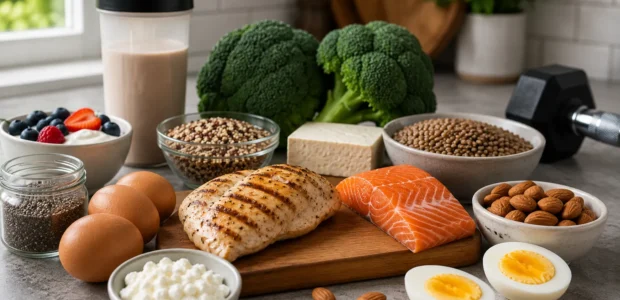

Muscle loss doesn’t announce itself. There’s no single moment where you wake up and notice it’s happening, it just quietly chips away in the background, starting earlier than most people realize. By the time it becomes obvious, in the form of stairs feeling harder or grocery bags suddenly seeming heavier, a fair amount of ground has usually already been lost.
Here’s the part that surprises a lot of people though. Protein needs actually go up as you age, not down, even though appetite and habits tend to move in the opposite direction. Let’s look at why a high protein diet for muscle preservation becomes so important after 40, and what the research actually says about it.
What Happens to Muscle After 40
The gradual muscle loss that comes with aging has a name, sarcopenia, and it can begin as early as your thirties, picking up speed with each passing decade. Part of the reason comes down to something researchers call anabolic resistance. As muscle ages, it simply becomes less efficient at responding to protein. The same amount that once triggered a strong muscle building response in your twenties now needs a bit more to produce the same effect.
This is really the core reason a high protein diet for muscle mass matters so much more now than it did at 25. Your body isn’t broken, it’s just working with a higher threshold than it used to.
Why More Protein Is Needed, Not Less
Research backs this up clearly. Studies looking at adults over 50 have found that those eating more protein than the standard baseline tended to hold onto more lean muscle and grip strength compared to those staying closer to the minimum recommended amount. A range commonly cited for older adults sits around 1.0 to 1.2 grams of protein per kilogram of body weight, noticeably higher than the general baseline used for younger, healthy adults.
That said, everyone’s situation is a little different. Kidney health, activity level, and other individual factors all play a role, so checking with a doctor or dietitian is the safest way to land on the right number for you specifically, rather than applying a blanket figure to every body.
Protein’s Role in Muscle Recovery, Not Just Growth
It isn’t only about building new muscle either. After 40, recovery from workouts, and honestly even from regular daily activity, tends to slow down. Adequate protein supports the repair of muscle tissue that naturally breaks down through everyday movement, not just structured exercise sessions at the gym.
This is exactly where a high protein diet for muscle recovery becomes just as important as one aimed purely at building mass. Recovery and preservation go hand in hand here, and both depend heavily on getting enough protein consistently.
Spreading Protein Across the Day Matters Too
How you distribute your protein throughout the day turns out to matter almost as much as how much you eat overall. Research points to spreading protein intake across meals, rather than saving most of it for one big dinner, as more effective for triggering muscle protein synthesis in older adults.
In practical terms, this means aiming for a solid protein source at breakfast, lunch, and dinner, rather than a small amount early in the day followed by a large serving at night. This approach works with your body’s aging metabolism instead of against it.
Pairing Protein With Movement for Real Results
Protein alone helps preserve muscle, but pairing it with resistance or strength training amplifies the effect considerably. Consistently, research points to this combination, adequate protein plus regular strength based movement, as the most effective approach for slowing age related muscle loss, far more than relying on diet or exercise alone.
If you’re looking to build strength training into your routine alongside better protein habits, Stay Fit Deals is a great place to start. The site brings together savings on a wide range of protein supplement brands, along with gym memberships and other fitness products, all through verified discounts, coupons, and deals, so building this kind of routine doesn’t have to strain your budget.
A Word on Balance
It’s worth noting that more protein isn’t automatically better. Some research on very high protein intake, well beyond the ranges discussed here, hasn’t shown extra benefit and in certain studies was even linked to different outcomes worth further investigation. The evidence really supports a moderate increase over the standard baseline, not an extreme one.
The Bottom Line
Preserving muscle after 40 isn’t about chasing an intense diet or overhauling everything overnight. It comes down to consistent, adequate protein spread across your meals, paired with regular movement that challenges your muscles. Small, sustainable shifts in how you eat, kept up over months and years, add up to a meaningful difference in how strong and capable you feel as you get older.