


Knowing you should track exercises is one thing. Actually having a system that sticks around past week two is a completely different challenge. Most people start strong, log a few workouts, then quietly abandon the whole thing once life gets busy. Here’s the good news though, how to track fitness progress isn’t really about finding one perfect metric or the fanciest app available. It comes down to finding a method you’ll genuinely keep using.
Let’s walk through a practical comparison of tracking methods, what’s actually worth logging, and how often to check in on it.
Pick Your Primary Method First
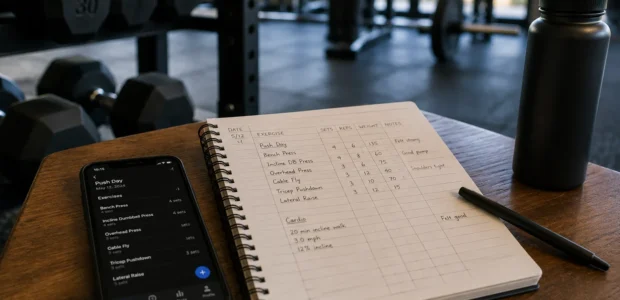
Before anything else, decide which tool you’re actually going to reach for consistently. A notebook offers low friction and zero distractions, no notifications pulling your attention mid set, just you and a pen. It’s a great fit if you don’t want technology involved in your training at all, though spotting long term trends takes a bit more effort since you’re flipping back through pages rather than glancing at a chart.
An app solves that problem directly, offering instant charts, autosave, built in rest timers, and exercise libraries that make logging almost effortless. If you want automation and quick visual feedback on your progress, this is usually the easiest starting point.
A spreadsheet sits at the more advanced end. It’s the most flexible option for custom calculations, things like weekly training volume or percentage based progression, and it suits lifters who genuinely want control over how their numbers are calculated. None of these three is objectively better than the others, the best way to track workout progress is simply whichever one you’ll actually stick with long term.
The Hybrid Approach: Best of Both Worlds
If you’re torn between options, a hybrid setup might be the answer. Jot down quick notes in an app or notebook during your actual workout, then transfer everything into a spreadsheet once a week for deeper analysis. This gives you simplicity in the moment when you’re focused on lifting, while still building a more detailed picture over time.
It’s a genuinely practical middle ground for anyone who isn’t ready to commit fully to one single method just yet.
What to Actually Log Each Session
Whichever method you land on, keep your template simple. At minimum, record the date, the type of workout, the exercises performed, and your sets, reps, and weight used. Add a short notes field too, how the session actually felt, your energy level, anything that stood out either positively or negatively.
This simple structure is really the foundation of how to measure fitness progress accurately over time, not just within a single workout. Consistency in the format matters more than the amount of detail you capture.
How Often to Review What You’ve Logged
Logging without reviewing is only half the system. Check in daily with a quick glance comparing today’s session to your last one. Weekly, look at whether you actually hit your target training frequency and volume. Monthly, step back and look for real trends, pairing your log with a measurement or a progress photo if you’re using those too. Quarterly, take a bigger step back and assess whether your entire program is still working or needs adjusting.
Reviewing consistently matters just as much as logging consistently, since a log nobody looks back on doesn’t do much good.
Use Your Log to Apply Progressive Overload
Here’s where tracking actually pays off. Progressive overload, gradually increasing weight, reps, or effort over time, is the core principle driving long term strength and fitness gains. Your tracked history is what tells you exactly when it’s time to add weight or reps, rather than guessing based on how you feel that day.
This is where your track exercises data turns from a simple record into real, actionable direction for your next session.
Keep It Simple Enough to Stick With
The biggest risk with any tracking system was never inaccuracy, it’s abandoning the whole thing after two weeks because it felt like too much work. Choose the simplest possible version of whichever method you pick. You can always layer in more detail later, once the actual habit of logging feels automatic rather than like a chore.
If you’re building out your setup, Stay Fit Deals is genuinely worth a look. The site features discounts on fitness trackers and training equipment from a wide range of brands, making it easier to get set up for consistent logging without spending more than you need to.
The Bottom Line
The best system for how to track your fitness progress isn’t the most detailed or technical option available, it’s the one that actually matches your lifestyle closely enough that you’ll keep using it. Start simple, stay consistent, and let your log slowly become the real, honest record of your progress over time.