

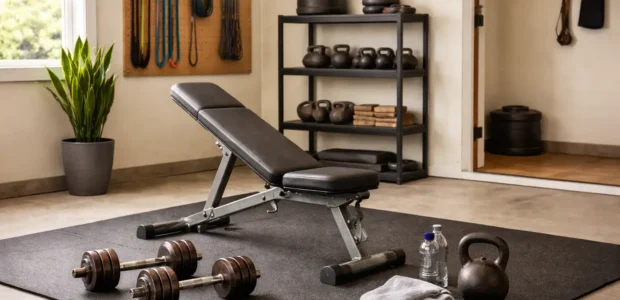

I used to spend $60 a month just to wait twenty minutes for a squat rack that smelled like someone else’s gym bag. When I finally looked at my bank statement and realized I was paying a premium to fight for floor space, I knew something had to change. But then I saw the $1,200 price tags on “pro” home equipment and almost gave up. I thought creating a home gym was only for people with a spare wing in their house and a massive budget.
I’m here to tell you, from a girl who started her journey with two pairs of second-hand dumbbells I found at a garage sale that you can build a powerhouse of a gym without draining your savings. I’m not a trainer; I’m just someone who got tired of the excuses and the commute. Making a home gym is about reclaiming your time and working out in your pajamas if you feel like it.
Let’s dive into how to build a home gym that actually gets results without hitting your wallet as hard as a heavy deadlift.
The Rise of the Affordable Fitness Space
The biggest hurdle for most people isn’t the workout itself; it’s the friction of getting there. When I finally decided to stop paying $600+ a year for a membership I only used thrice a week back then, I realized that creating a home gym was the way to go. It’s about reclaiming your time. No more waiting for the squat rack.
In reality, recent %year% fitness industry data reveals a staggering truth: Americans waste approximately $1.3 billion annually on unused gym memberships. By contrast, a home gym is an investment in physical assets. Even if you only start with the basics, you are building a private facility that breaks even in as little as 18 to 24 months. I’m here to show you how to build a home gym that grows with your progress, focusing on a high “bang-for-your-buck” ratio.
Phase 1: Planning Your Simple Home Gym Set Up
Before you spend a dime on gear, you have to audit your space. I’ve seen people build incredible setups in a 6×6 bedroom corner or a section of a damp garage. The first rule of a simple home gym set up is floor protection.
Do not. I repeat. Do not buy those colorful, interlocking foam tiles from the toy section. They are too soft, they slide, and they’ll compress permanently under a heavy bench. Instead, head to a tractor or farm supply store and buy “Horse Stall Mats.” These are ¾-inch thick vulcanized rubber. They usually cost about $50 for a 4×6 sheet, which is nearly 60% cheaper than “pro” gym flooring, and they are virtually indestructible.
Next, think about the atmosphere. If your gym set up at home feels like a dungeon, you won’t want to be there. I added a $20 set of LED shop lights and a cheap full-length mirror from a thrift store. The mirror isn’t just for checking your pump; it’s a safety tool to monitor your form when you don’t have a coach watching your back.
Phase 2: The “Big Three” Essentials: Best Home Gym on a Budget
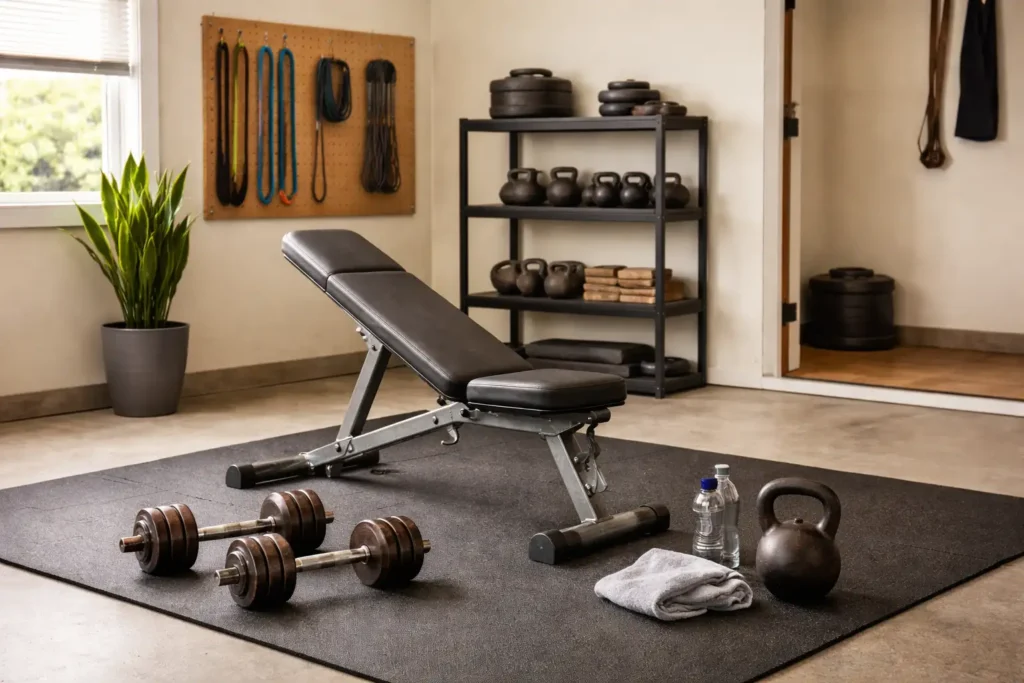 If you only have a few hundred dollars, you need to be surgical with your spending. When looking for the best home gym on a budget, I always point people toward the “Big Three.”
1. Adjustable Dumbbells
A full rack of dumbbells is a dream, but it’s a nightmare for your wallet and your floor space. A quality set of adjustable dumbbells can replace up to 15 pairs of traditional weights. Even a basic “spin-lock” set that uses standard 1-inch plates is a great starting point for an inexpensive home gym.
2. The Multi-Purpose Bench
This is your foundation. You need something that can handle your body weight plus the weights you’re lifting. Look for a bench that offers flat, incline, and decline positions.
You will have to invest a bit more in this one piece of equipment, but it’s worth it because it serves multiple purposes and supports a wide range of exercises. Spend a little more here for a bench rated for at least 500 lbs. It’s a one-time purchase that ensures you won’t end up on the floor mid-press.
That said, you don’t need to buy it right away when setting up your home gym. You can start with basic equipment and build your routine first. Once you get more consistent and want to move into heavier lifting and more advanced strength training, that’s the right time to add a bench to your setup.
3. Resistance Bands
These are one of the most useful tools you can add to a budget home gym. Resistance bands are affordable, take up almost no space, and still allow you to train your entire body effectively.
What makes them especially valuable is their versatility. You can use them for exercises like lat pulldowns, chest presses, bicep curls, rows, and even assisted pull-ups—movements that are harder to replicate with just dumbbells. They also add variable resistance, meaning the tension increases as you stretch the band, which helps improve muscle control and strength throughout the movement.
For a budget setup, resistance bands fill in the gaps where heavier or bulkier equipment isn’t available. They’re also great for warming up, improving mobility, and adding extra intensity to your workouts without needing to invest in more weights.
Read More: Best Workout Equipment for Home – Essentials for Working Out
Phase 3: Specialized Gear: Home Gym Ideas on a Budget
Once the foundation is set, you can start adding “force multipliers.”
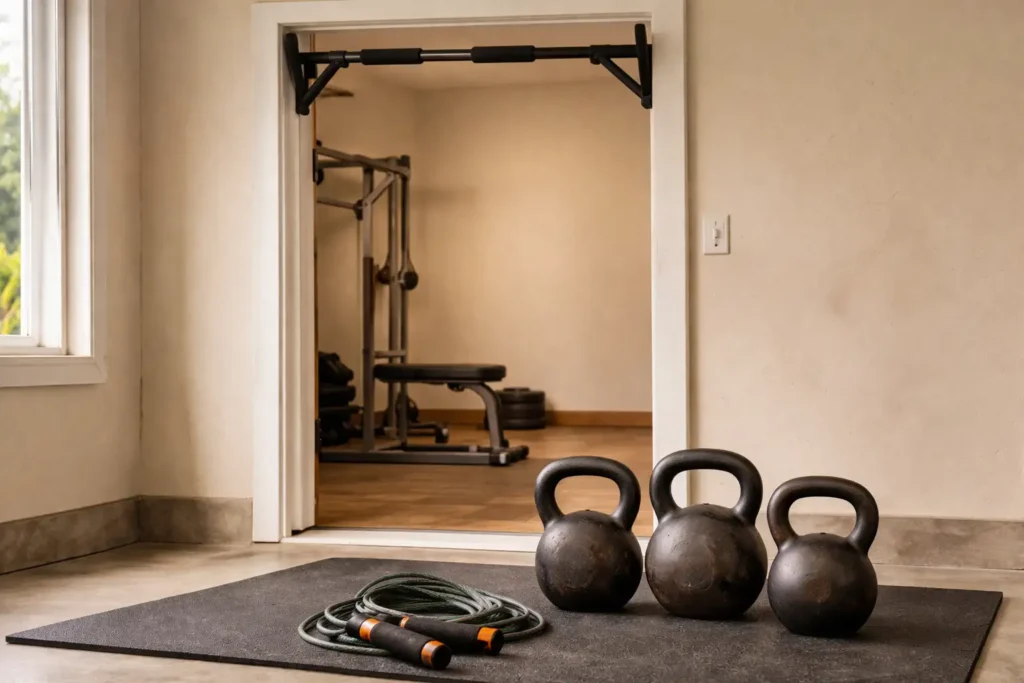
Bodyweight Staples: I always tell people to get a doorway pull-up bar. It’s around $35 and gives you a world-class back workout. If you’re worried about your door frame, look into a “Power Tower” on the used market.
Cardio Without the Treadmill: A high-quality jump rope is the undisputed king of home gym ideas on a budget. You can burn roughly 10–15 calories per minute jumping rope—equivalent to a 6-mph run—without needing a $1,000 motorized machine.
Kettlebells: If you can only afford one extra piece of gear, make it a 16kg (35lb) or 24kg (53lb) kettlebell. Swings, goblet squats, and Turkish get-ups provide a hybrid of cardio and strength that is hard to beat in a simple home gym set up.
Strategic Shopping: How to Save More
Here is the truth: Steel doesn’t expire. A 45lb plate made in 1980 still weighs 45lbs today. When you’re making a home gym, your first stop should always be the used market.
Facebook Marketplace, Craigslist, Good Will and OfferUp are goldmines. During the “home gym boom” of the early 2020s, prices skyrocketed, but now they’ve stabilized. You can often find weights for $0.60 to $0.80 per pound, whereas buying new at a big-box retailer will run you $1.50 to $2.00 per pound.
Pro-Tip: Check these sites and stores in late March or early April. This is the “Resolution Burnout” period when people realize they aren’t using the gear they bought in January and just want the space back in their garage. That’s when you find the best deals for an inexpensive home gym.
Phase 4: Maintenance and Motivation
The biggest challenge with a home gym setup is that it becomes invisible. If it’s a mess, you’ll avoid it. I use a simple pegboard to hang my bands, jump ropes, and collars. It keeps the floor clear and makes the room look like a place of business.
To keep the motivation high, I treated my gym like a project. I put up a whiteboard to track my personal records (PRs). There is something incredibly satisfying about physically crossing off a goal in your own space. Also, invest in a decent Bluetooth speaker. Your music, your rules and no more listening to the generic pop-remixes they play at the commercial gym.
Conclusion
Building an inexpensive home gym is a marathon, not a sprint. My gym didn’t look like it does today when I started. It was a slow process of swapping out old gear for better pieces as I saved money.
Start with the floor and the “Big Three.” Once you have those, you have everything you need to reach 95% of your fitness goals. Take the money you would have spent on that monthly membership, put it in a “Gear Fund,” and every few months, treat yourself to a new kettlebell or a better barbell.
How to build a home gym isn’t just a DIY project; it’s an investment in a version of yourself that has no excuses left. So, what’s stopping you from clearing out that corner today?
At the same time, finding the right gear at the right price can make a big difference when you’re building your setup. Platforms like Stay Fit Deals help you spot verified discounts on home workout equipment, training programs, and recovery tools without the usual guesswork.
It’s especially useful when you’re ready to upgrade—whether that’s adding a bench, kettlebell, or better accessories—so you can make smarter purchases and get more value out of every dollar you spend.
FAQs
How much does it cost to build a home gym on a budget?
You can start a basic home gym for $100–$300 with essentials like dumbbells, bands, and floor mats.
What is the most important equipment for a home gym?
Adjustable dumbbells, resistance bands, and a sturdy bench cover most strength training needs.
Can you build muscle with a home gym?
Yes, with consistent training and progressive overload, you can build muscle effectively at home.
Is a home gym cheaper than a gym membership?
Yes, a home gym can pay for itself over time by eliminating monthly membership fees.
What is the best space for a home gym?
A spare room, garage, or even a small corner with proper flooring and lighting works well.
Do I need cardio equipment for a home gym?
No, options like jump ropes, bodyweight exercises, and HIIT workouts can replace machines.
How can I stay motivated with a home gym?
Keep your space organized, track progress, and create a routine to stay consistent.